

Blog
Redefining the Cut: How High-Frequency Electric Wall Saws Enable Precision Engineering

In building renovation, metro construction, and heritage restoration projects, precision is no longer optional—it is a requirement.
Across these job sites, a new standard has emerged: high-frequency electric wall saw systems, designed to deliver controlled, low-impact concrete cutting with predictable results.
Mounted directly to reinforced concrete surfaces and operating with continuous water cooling, these systems perform accurate cuts with minimal noise, negligible vibration, and full process control, redefining how structural modification is executed in modern construction.


1. System Architecture: Engineering Behind Precision Cutting
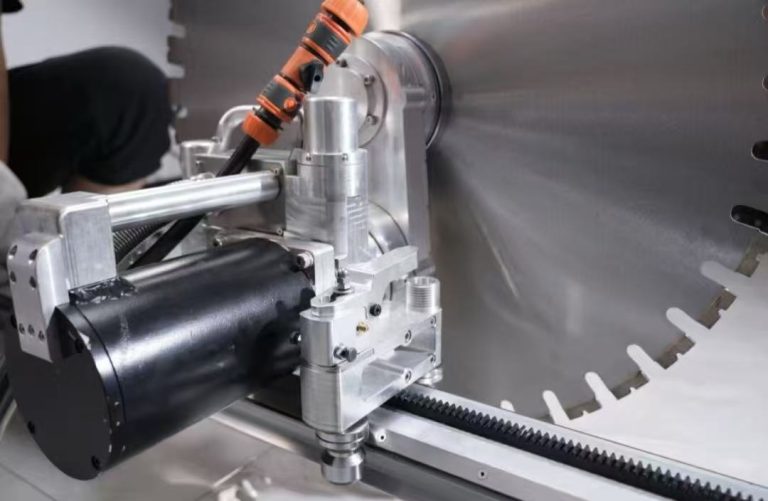
A high-frequency wall saw is not a standalone machine. It is an integrated cutting system, engineered to ensure stability, accuracy, and repeatability under demanding site conditions.
High-Frequency Motor and Inverter System
At the core is a high-frequency electric motor paired with a dedicated inverter.
By converting standard electrical input into high-frequency power, the system achieves:
- Higher torque density in a compact form factor
- Precisely controlled rotational speed
- Stable power output across varying load conditions
This architecture eliminates power fluctuations commonly associated with hydraulic systems, enabling consistent cutting performance.
Structural Rail and Traveling Carriage
Cut accuracy depends on mechanical rigidity.
High-frequency wall saws utilize high-stiffness guide rails, typically manufactured from aerospace-grade aluminum, providing a stable reference axis.
The motor carriage travels along the rail with controlled feed rates, ensuring:
- Straightness over long cuts
- Consistent depth control
- Dimensional accuracy within millimeter tolerances
Diamond Cutting Interface
The cutting process is executed using engineered diamond wall saw blades, selected based on concrete strength, aggregate composition, and reinforcement ratio.
Optimized segment formulation and bond selection allow:
- Controlled interaction with rebar
- Reduced blade glazing
- Predictable tool life and cutting speed
Cooling, Dust Control, and Digital Monitoring
Continuous water cooling serves multiple functions: thermal regulation, dust suppression, and cut surface protection.
Modern control units integrate:
- Load monitoring
- Overcurrent and thermal protection
- Parameter storage for repeat operations
- Fault diagnostics for preventive maintenance


2. Why Electric Drive Systems Outperform Hydraulic Alternatives
The industry’s transition from hydraulic to direct electric drive wall saws is driven by measurable operational advantages.
Energy Efficiency and Lifecycle Cost
Electric drive systems reduce energy loss by 25–40% compared to hydraulic equivalents.
Eliminating hydraulic oil circuits also removes leak risks, contamination concerns, and routine fluid maintenance—lowering total cost of ownership.
Cutting Quality and Structural Protection
Stable electric motor output enables controlled, non-impact cutting, even when encountering high rebar density.
This minimizes microcracking and protects surrounding structures, which is critical in renovation and retrofit applications.
Noise and Vibration Control
Electric wall saws operate at significantly lower noise levels and vibration values (typically <0.5 mm/s), supporting:
- Work in occupied buildings
- Compliance with urban noise regulations
- Reduced operator fatigue
Operational Safety and Process Consistency
Digital control interfaces standardize cutting parameters, reducing dependence on operator experience alone.
Integrated electrical protection systems further enhance on-site safety.
3. Application Scenarios Where Precision Is Non-Negotiable
Structural Modification in Heritage and Retrofit Projects
Creating openings for elevators, mechanical systems, or structural reinforcements requires absolute control.
High-frequency wall saws allow precise, non-destructive intervention, preserving structural integrity and historical elements.
Infrastructure Intervention Under Live Conditions
Metro tunnels, bridges, and retaining structures often remain operational during modification.
Low-impact electric wall sawing enables work without disrupting traffic or inducing structural stress.
Controlled Cutting in High-Risk Environments
In chemical plants, power facilities, or clean industrial sites, electric drive systems provide:
- No oil leakage risk
- Lower surface temperatures
- Compatibility with explosion-control protocols
Remote operation options further reduce personnel exposure.
Urban Construction with Environmental Constraints
In dense urban areas, restrictions on noise, dust, and working hours are unavoidable.
Electric wall saws with water-based dust suppression support compliance-ready construction, even in sensitive zones.
4. Technology Direction: Data-Driven and Integrated
Advanced systems now incorporate IoT-enabled monitoring, allowing real-time performance tracking, predictive maintenance, and centralized fleet management.
Integration with laser scanning and BIM workflows enables digital-to-physical execution, supporting complex geometries and reducing rework risk.
Precision Cutting as a Construction Standard
High-frequency electric wall saws represent a shift from demolition-driven methods to precision-controlled structural processing.
They enable engineers and contractors to execute modifications with predictability, reduced risk, and measurable quality outcomes.
For project stakeholders, the value proposition extends beyond equipment cost—delivering shorter schedules, lower indirect expenses, regulatory compliance, and superior final results.
As construction moves toward refined, data-driven execution, electric wall sawing technology is no longer optional—it is the benchmark.